The Reality of Solar and Utility Interconnection Fees when Net Metering
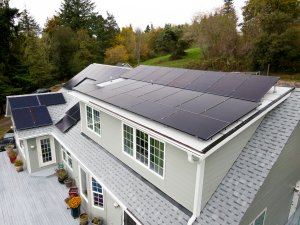
One of our recent customers at Premier Solar NW was only paying the utility’s standard interconnection fee each month – the mandatory charge for all customers, whether they have solar or not. As a result, they never had to pay for electricity.
Over the course of a year, their system generated more energy than they consumed. They assumed they could install an automatic transfer switch (ATS) and power their home indefinitely, anytime they needed. This is a common misconception. It’s important to understand why a homeowner with solar panels and a zero electricity bill still wouldn’t be able to rely solely on an ATS to solve all their energy needs.
How Net Metering Works in Oregon
The main difference here is between net metering and off-grid living or power outages. Net metering allows a home with solar panels to be credited for excess generation in the summer and have those energy credits applied to the bill in the winter when the solar isn’t able to keep up with the home’s energy consumption.
In Oregon, our net metering is 1:1 so every kWh pushed into the grid is returned with an equal kWh credit. This allows our designers to customize the solar system’s yearly estimated production to match the home’s yearly estimated energy consumption. This is important in the Pacific Northwest area because we have long sunny summer days and short days with grey skies in the winter. This video from Energy Sage has a good overview of net metering if you want a more visual review.
Real-Life Example: Solar Power and Battery Storage in Winter
The following is an example of one of our customers inquiring about how much battery storage they would need to add, if any, to keep living the way they are during power outages.

December Bill from PGE: Understanding Net Metering Credits
Net-metering Breakdown:
- From the bill shown above, the net consumption in December is 1,690 kWh
- Your home pulled 1,690 kWh from Portland General Electric (PGE), or 55 kWh/day on average
- This means that most of the time, the home was using more energy than the solar system was providing
- Sometimes, the solar system was generating more than the home was using at a given time
- In total, the solar system pushed 155 kWh into the grid
- They didn’t pay anything because PGE applied 1,535 kWh worth of credits, “Energy savings withdrawn,” that they had built up during the summer
- The system didn’t physically generate enough energy to cover the home’s usage this month
The reason they didn’t have to pay for electricity this month is that they had enough credits in their account to cover the difference. This is the net-metering process in Oregon.
Seasonal Solar Generation and Consumption Patterns
The following graphic shows the same home’s expected solar generation and consumption. The yellow bars are solar generation and the grey line backdrop is the home’s energy consumption, both in kWh/day. Overall, their system is generating 106% of their yearly energy usage.

Summer (April through October)
- Generation is higher than consumption
- Solar is producing more energy than what the home uses on a given day
- During these months they’re earning credits towards their account equal to the excess energy generated from the solar system
- By the end of the summer, they have over 4,000 kWh in credits
- That pool of credits will then be applied to their bills in the winter on months when the system isn’t generating as much as the home uses
Winter (November – February)
- Yellow bars are lower than the grey line
- The system is not generating enough energy to cover the home’s usage on a day-to-day basis
- They’re not paying for electricity because the credits built up in the summer are applied to the bills in the winter
Can Solar Panels and Batteries Provide Off-Grid Power in Winter?
Billing aside, disregard the fact they’re not paying anything for electricity in the winter. If the grid goes down during the winter, the solar system will be producing less than the home uses on a day-to-day basis.
Using 55 kWh/day, with 17 kWh/day in solar generation, they would need around 40 kWh to get through a day-long outage in the winter. If the outage lasts more than a day, the solar system would be providing around 17 kWh each day after the batteries are drained on day one.
Why Net Metering and Battery Backup Are Two Different Things
How much you pay for electricity per month is a factor of net metering applying credits built up in the summer towards your bills in the winter. How long a battery will last in the winter is a completely separate situation and how much you’re paying for electricity in that month is completely irrelevant to how long the battery system will last during a power outage.
However many batteries they get, they won’t be able to power them indefinitely through an outage during the winter because the solar system isn’t capable of providing the amount of energy the home needs day to day.
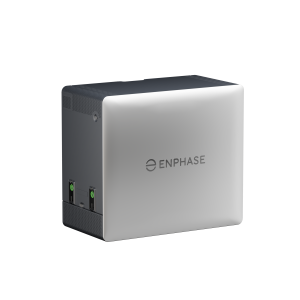
How many batteries a system needs depends on the energy demands of the home and the length of outage you want to be ready for. More often than not, a solar and storage system will not be able to provide indefinite off-grid living through a PSNW winter. Pairing a gas or propane standby generator and lowering the energy demands of the home are common ways to get by during longer winter outages.
What It Takes to Live Off-Grid with Solar in the Winter
If someone wants to live without energy restrictions on a solar and storage system in the winter, their system’s daily winter production needs to meet their daily usage, and the batteries must store enough energy to get through the night.
An all-electric home would need a very large and expensive solar and storage system to make that happen, even with the most efficient appliances. Even a home relying on gas appliances for heating, cooking, and water heating would struggle to get by due to long stretches of overcast skies typical of a Pacific Northwest winter.
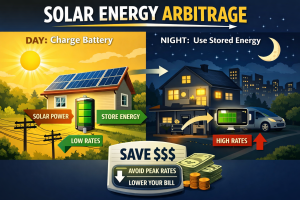
To summarize, net metering offered by local utilities makes solar financially attractive in places like Oregon and Washington. Our sunny summer days allow your bill to build credits in the summer to be used in the winter when there isn’t enough sun to cover day-to-day energy demands. Energy storage has its place in providing energy independence, and there are ways to make a financial return as well. Future content will explore sizing battery systems and how to save money with price arbitrage using utility time-of-use programs.
Get Expert Solar Consultation
If you have additional questions, please reach out! We provide a free phone consultation, and our services are available in Oregon and Washington.