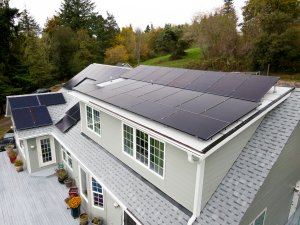
Albert Einstein’s great E=mc2 discovery paved the way for harnessing the sun’s energy and converting that energy to usable electricity. His work on the photovoltaic effect not only provided insight into how light interacts with matter but also laid the groundwork for developing solar technology as we know it today.
The Photovoltaic Effect
The photovoltaic effect refers to the phenomenon where certain materials generate an electrical current when exposed to light. In 1905, Einstein published a paper that addressed this effect, explaining how light behaves as a stream of particles called photons, which possess quantized energy. His groundbreaking proposition was instrumental in understanding how these photons can impart energy to electrons within a material, causing them to be emitted, thus generating an electric current.
This discovery was pivotal because it provided a scientific foundation for converting light energy into electrical energy. Though Einstein’s work itself did not result in a practical solar panel, it sparked an interest that would ultimately lead to the development of solar technology.
E=mc²: Energy, Mass, and Light
Einstein’s famous equation, E=mc², illustrates the relationship between energy (E), mass (m), and the speed of light (c). While it primarily describes the equivalence of mass and energy, it indirectly relates to the photovoltaic effect. The equation suggests that energy and mass are interchangeable, implying that light possesses energy and can affect the material world.
When photons strike a solar cell, they transfer their energy to electrons in the material. In semiconductors, commonly used in solar panels, this energy is sufficient to overcome the binding energy holding the electron in place. As a result, the electron is freed and can flow through the material, creating an electric current.
From Theory to Solar Panels
The first practical solar cell was developed in 1954 by researchers at Bell Labs, who built upon Einstein’s theoretical framework. This solar cell was made from silicon, a semiconductor material that effectively converts sunlight into electricity. The cells consist of layers of silicon doped with other elements (like phosphorus and boron) to create a junction that facilitates the flow of electricity when light hits the cell.
When sunlight strikes the silicon solar panel, photons penetrate the surface and collide with the silicon atoms. This interaction excites the electrons, knocking them loose in a controlled manner. The design of the solar cell ensures that these freed electrons are directed into an electric circuit, providing us with usable electricity.
The Impact of Solar Technology
The invention of solar panels has transformed how we harness energy, providing a clean, renewable source of power that reduces reliance on fossil fuels. As technology has advanced, solar panels have become more efficient and accessible, allowing individuals and businesses to capitalize on solar energy.
Einstein’s work highlights the beauty and complexity of nature, illustrating how understanding the fundamental properties of light can lead to remarkable technological advancements. Today, as the world moves towards sustainable energy solutions, the principles laid down by Einstein continue to guide innovations in solar technology.
Conclusion
Albert Einstein’s contributions to understanding the photovoltaic effect and the nature of light have significantly influenced renewable energy solutions available today. His work in physics not only brought insights into mass-energy equivalence but also brought about the practical application of converting sunlight into electricity. As we advance into a future that prioritizes renewable energy, the foundations laid by Einstein will continue to illuminate our path toward sustainable living.
Sources
NASA
https://science.nasa.gov/sun/how-nasa-uses-and-improves-solar-power
US DOE
https://www.energy.gov/eere/solar/solar-photovoltaic-technology-basics
https://www.energy.gov/eere/solar/articles/pv-cells-101-primer-solar-photovoltaic-cell
Stanford Energy
https://understand-energy.stanford.edu/energy-resources/renewable-energy/solar#fast-facts-header
Britannica
https://www.britannica.com/science/light
APS
https://www.aps.org/apsnews/2005/01/einstein-photoelectric-effect